 Fire & EMS Leader Pro The job of old firefighters is to teach young firefighters how to become old firefighters!
By: Robert Avsec, Executive Fire Officer, Operations Chief at Fire Service Psychology Association
In today’s fire service, conversations about readiness are no longer limited to hose lines, turnout gear, or cardiac fitness. Increasingly, the most critical component of operational readiness is the one we can’t see: psychological fitness.
Firefighters and EMS professionals operate in environments defined by chaos, trauma, and split-second decision-making. Yet, despite these realities, many departments still rely on psychological assessment tools that were never designed for the fire service—or worse, skip them altogether.
That gap creates risk—not just to the individual firefighter, but to the organization, the community, and the long-term sustainability of the profession. It’s time to rethink the role of psychological evaluations—not as a compliance checkbox, but as a strategic tool across the entire employment lifecycle: pre-employment, fitness for duty, disability management, and workers’ compensation.
Fire Departments Need a Better Standard
Firefighting is not just physically demanding—it is psychologically unique.
Firefighters are routinely exposed to traumatic events, including death, severe injuries, and high-stress emergencies. Over the course of a career, that exposure accumulates. Research shows firefighters experience repeated traumatic incidents and face significantly elevated risks of PTSD, depression, and anxiety [1] [2].
At the same time, the job requires:
• Calm decision-making under extreme pressure
• Emotional regulation in life-and-death scenarios
• Trust-based teamwork in dangerous environments
• Resilience across long careers of cumulative stress
Generic psychological tools—especially those adapted from law enforcement or corporate settings—fail to measure these realities accurately. In fact, using non-fire-service-specific criteria can lead to flawed hiring or duty decisions and creates legal and ethical risks [3].
Bottom line: The fire service needs assessment tools built specifically around its job demands, culture, and risks.
The Fire Service Psychology Association’s PROJECT SENTINEL has three Task Groups that are working on developing psychological guidelines for the fire service. Task Group BRAVO is working on guidelines for psychological assessments (e.g., pre-employment, fitness for duty, Worker’s Comp, and disability) that are fire service specific and evidence based. Learn more.
Pre-Employment Screening: Building the Right Foundation
Every chief knows: you don’t build a great department—you hire one.
Pre-employment psychological assessments help departments identify candidates who possess:
• Stress resilience
• Sound judgment under pressure
• Emotional stability
• Team compatibility
These are not “nice-to-have” traits—they are mission-critical competencies [4]. Without valid, fire-service-specific tools, departments risk hiring individuals who:
• Struggle under operational stress
• Contribute to toxicity or conflict
• Burn out quickly
• Increase liability exposure
Poor hiring decisions don’t just impact performance—they ripple across morale, supervision demands, and long-term retention [5]. When done right, psychological screening becomes a force multiplier—improving cohesion, culture, and public trust from day one.
Fitness-for-Duty Evaluations: Enhancing Safety and Careers
A firefighter’s ability to perform their job safely isn’t static—it evolves over time. Fitness-for-duty (FFD) psychological evaluations play a crucial role when concerns arise, such as:
• Behavioral changes
• Performance decline
• After critical incidents
• Return-to-work following injury or illness
These evaluations should not be punitive. They should be designed to answer one key question:
Can this individual safely and effectively perform essential job functions right now?
FFD psychological assessments provide objective, legally defensible guidance to departments, helping determine whether a firefighter is:
• Fit for duty
• Fit with support or treatment
• Temporarily unfit but recoverable
This process protects:
• The safety of crews and the public
• The dignity and career of the firefighter
• The legal position of the department
When grounded in fire-service-specific standards, these evaluations are far more accurate and defensible.
Disability and Workers’ Compensation: Bringing Clarity to Complex Cases
Mental health claims in the fire service—particularly those involving PTSD—are increasing and becoming more complex. Many states now recognize that firefighters can suffer “mental-mental” injuries—psychological trauma without a physical injury—and allow them to qualify for workers’ compensation benefits [6].
At the same time:
• PTSD claims are often presumed work-related in some jurisdictions
• Departments face rising costs and legal scrutiny
• Determining causation and impairment can be difficult
This is where specialized psychological assessments become essential. Fire-service-specific tools can:
• Establish baseline psychological functioning
• Provide objective data on impairment and causation
• Support fair, defensible claims decisions
• Reduce disputes and litigation risk
Without standardized, job-relevant assessments, departments are left navigating high-stakes decisions with incomplete or inappropriate data.
A Powerful Tool for Recruitment and Retention
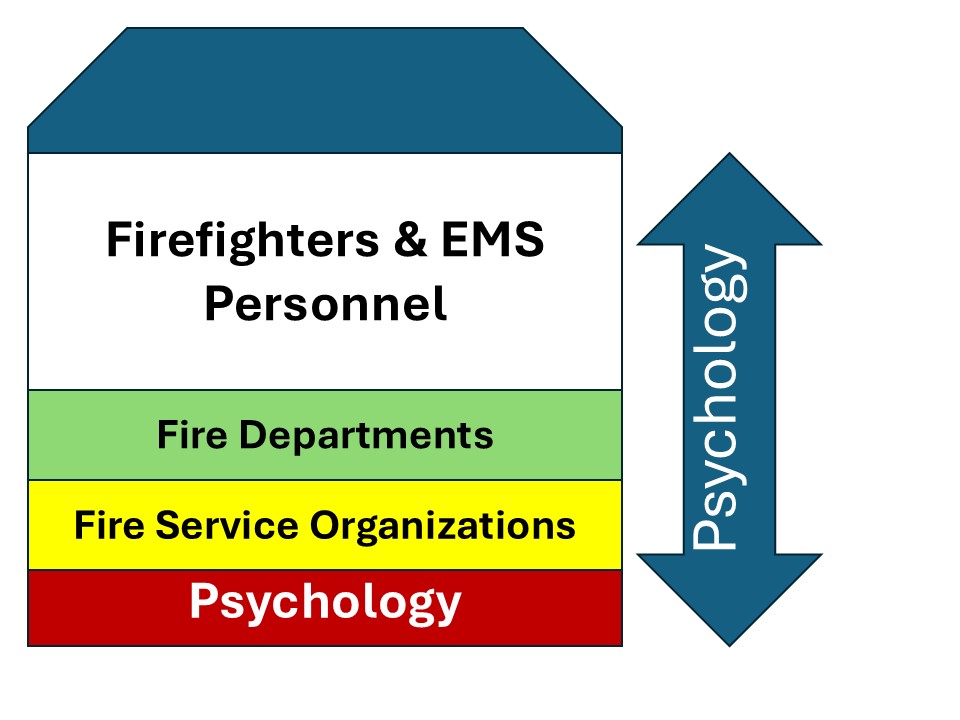
The component for psychological services for firefighters and EMS personnel are akin to that of a house: Both need a strong foundation. The discipline of psychology must form the foundation for the former.
Here’s where many departments miss the opportunity: psychological assessments aren’t just about reducing risk—they’re about gaining insight. When aggregated and analyzed properly, assessment data can help departments:
• Identify traits linked to successful long-term firefighters
• Understand why people leave (burnout, stress tolerance gaps, etc.)
• Refine recruiting messaging to attract better-fit candidates
• Build more resilient, engaged teams
This is especially important as departments nationwide face recruitment and retention challenges. We already know that the following play major roles in keeping firefighters engaged and committed:
• Organizational culture
• Mental health support
• Job satisfaction
Psychological assessment data helps departments move from assumptions to evidence-based decision-making when it comes to recruitment and retention.
Moving Beyond Generic Tools: Why Customization Matters
Perhaps the most important point of all: Not all psychological assessments are created equal.
Using tools designed for other professions—especially law enforcement—creates serious limitations:
• Misalignment with fireground decision-making demands
• Inaccurate interpretation of stress and risk tolerance
• Potential legal vulnerability due to invalid criteria [7]
Fire service–specific assessments, on the other hand, are built around:
• Actual essential job tasks
• Real-world operational stressors
• Firehouse culture and team dynamics
• Career-long exposure to trauma
They don’t just measure “mental health”—they measure readiness for this job.
The Strategic Advantage for Fire Departments
Fire departments that invest in purpose-built psychological assessment programs gain a measurable advantage in:
Operational Benefits
• Better hiring decisions
• Safer crews
• Improved performance under pressure
Organizational Benefits
• Stronger culture and cohesion
• Reduced turnover and burnout
• Data-driven leadership decisions
Risk Management Benefits
• Reduced liability exposure
• Defensible employment decisions
• Improved Workers’ Comp outcomes
Final Thoughts: A Leadership Responsibility
Fire service leaders are asked to make decisions every day that affect lives—both on the fireground and inside their departments. In an environment where mental demands are as intense as physical ones, relying on outdated or non-specific tools is no longer acceptable. Psychological assessments designed specifically for the fire service are not a luxury. They are:
• A measure to enhance safety
• A leadership tool
• A workforce strategy
And perhaps most importantly—they are a commitment to ensuring that the people we rely on in our worst moments are truly prepared for the job.
References
- International Association of Fire Fighter. (2025). Behavioral Health Statistics In the Fire Service: What Does Available Research Tell Us About the Incidence of Mental Health Challenges, Injury, And Disorders, Among Fire Fighters? Paper submitted to U.S. Senator Kirsten. <Available Online> https://www.gillibrand.senate.gov/wp-content/uploads/2025/07/Behavioral-Health-Statistics-in-the-Fire-Service.pdf
- U.S. Fire Administration. (2024). Mental Health and Wellbeing Workgroup. October 2023 to August 2024. <Available Online> https://www.usfa.fema.gov/downloads/pdf/summit/2024/2024-summit-mental-health-and-well-being-workgroup-report.pdf
- Wheldon, K. and Wolf, G. (2022). Psychological Employment Screening in the Fire Service Reducing Workplace Risk through Collaboration. Fire Service Psychology Association. White Paper. <Available Online> https://www.firepsychology.org/wp-content/uploads/2023/07/FIRE_PreemploymentScreening.pdf
- Firefighter 101. (2026). Firefighter Psychological Evaluation. Firefighter Test. <Available Online> https://firefighter101.co/firefighter-psychological-evaluation/
- Costa, C. (2025). The crucial role of pre-employment psychology exams in the fire service. FireRescue1.com. <Available Online> https://www.firerescue1.com/health-wellness/the-crucial-role-of-pre-employment-psychology-exams-in-the-fire-service
- Hanson, L. (2023). Eligibility Criteria for Workers’ Compensation Benefits for PTSD in First Responders. Research Report Submitted to the Connecticut Office of Legislative Research. <Available Online> https://www.cga.ct.gov/2023/rpt/pdf/2023-R-0266.pdf
- Wheldon, K. and Wolf, G. (2022). Psychological Employment Screening in the Fire Service Reducing Workplace Risk through Collaboration. Fire Service Psychology Association. White Paper. <Available Online> https://www.firepsychology.org/wp-content/uploads/2023/07/FIRE_PreemploymentScreening.pdf

